
10 Things Christians Need to Know About Destructive Marriages
I wish those who think I’m hard on marriage could read the messages I receive or spend time in the comments on my (and other advocates’) social media and blogs.
I wish all Christians could understand the profound impact of coercion and dominance: How intimate partner terrorism wrecks the mind, soul, and body, and the need for compassionate witnesses and empowerers.
I’m aware that those committed to exercising power over others and those who enable them are not given to empathy or that type of self-reflection.

But I know some Christians are disconnected from the experiences of others or follow oppressive systems because they think it’s the truth.
And so to them and for the hurting, I keep sharing truths in the hope of educating the open-minded and affirming the hurting.
Let’s talk about 10 things Christians need to accept about destructive marriages. Because we must do better.
10 Things I Wish Christians Understood about Destructive Marriages
1. Marriage advice that works for one couple might be a death sentence to another.
Just because it works for you doesn’t mean it’ll work for everybody.
There are regular (not necessarily acceptable) marriage issues and destruction by marriage: Many people in the first type of marriage project their experiences onto those in the second type. It needs to stop.
Here’s the thing we must understand. If one person doesn’t think the world revolves around their comforts, views, and pleasures, then that makes it possible to work through growth-related problems.
If two people have cultivated (a growing) capacity to receive feedback and take responsibility for themselves, they can address personal growth areas and explore how those impact their relationship.
As a matter of fact, decent, healthy folks choose according to what is good for the individual and their connection. And they seek to repair where there’s been a rupture.
In a destructive marriage however, the wounding partner chooses to “grow” in the direction that most benefits them. Any suggestion, growth, or maturation bows to the god of self.
And there can be no real connection, no repair, no future if only one person is doing the work of connecting. Because basically, “the relationship” is endless sacrifice by one individual and forever irresponsibility by the other.
- Read More
- 18 Things Normal Guys Don’t Do in Marriage (And 12 Things They Pursue)
- When a Spouse Won’t Address Harmful Character Issues (Clarity For Wives)
2. Abusers can be some of the “nicest” people you will ever meet.
I once heard a pastor say, “My relative was married to a violent man: I know an abuser when I see one.” He said that while trying to “marriage-counsel” and reconcile an abusive marriage.
Many Christians believe they can discern an abusive relationship. Like the pastor, they believe they are highly perceptive and aware.
However, all they have is a list of external characteristics they think abusers display and an uninformed notion of how victims present.
The reality is, most abuse is hidden. It goes on behind the scenes and it’s difficult to detect from the outside. Psychological, financial, verbal, sexual, emotional, cultural, and physical abuse happens in private and to think you’ll know because you know, is at best, foolish. (See Is This Abuse?)
I wish Christians understood that covert abusers spend ship-loads of energy tending to their public image. Unlike the average person, they think about and plan for how they come across to those they have chosen to “impress.”
The fact that most abusers are expert manipulators is one of the reasons hidden abuse rages. Because few want to believe the “kindly” person is grooming children or “that sweet guy” is terror-incarnate at home or the “devoted” Bible-study leader has financially abandoned his wife.
What I wish Christians understood about destructive marriages is the importance of believing victims Vs. relying on their own (very uninformed) experiences and interactions with the person being reported as harming.
3. Healthy couples in hierarchical marriages don’t practice hierarchy.
In their groundbreaking research on evangelical Christian marriages, the Bare Marriage team found out that the majority of people who believe in wife-only submission/husband making final decisions actually function without a tiebreaker.
“In these marriages, couples either make decisions together or forgo making a decision if they don’t agree. Many couples may say they believe the husband has the final say but their actions speak more to mutuality.” Source: The Great Sex Rescue: The Lies You’ve Been Taught and How to Recover What God Intended (aff.)
My husband and I supposed husband-leads-and-wife-submits was the universal Christian standard and what everyone did. Until a few years ago when I came across the phrases “Complementarian” and “Egalitarian.”
Then I discovered our way was not everyone’s way. So I dug around and read widely. And realized that what we said we practiced and what we actually did were two different things.
Christian couples who say the husband holds decision-making power in marriage, who are healthy, actually don’t have the husband operating as a decision-maker/leader.
Complementarianism doesn’t work as taught. And when it does “work” as taught, it harms.
- Read More
- Does the Complementarian Marriage Model Contradict Itself?
- Dear Complementarian Husband, A Marriage Operating Through a System of Power and Control is Abusive
4. Turning our backs on the wisdom of survivors of destructive marriages is bad for everyone.
It’s a common belief in the Christian circles that to divorce is to automatically be biased against all relationships.
Thus, the advice runs, one of the best ways married people can “protect” their marriages is to avoid advice from divorced people.
I wish Christians understood that one of the worst things they can do for marriages is to crawl up into a silo: To turn our backs on the wisdom of survivors of abusive marriages is bad for everyone.
I wish more Christians were open to exploring our discomfort.
Because then we might discover that perhaps one of the reasons we are uncomfortable with survivors instructing marriages is because an accurate view of health is terrifying where entitlements, exploitation, and coercion have been accepted as the baseline.
Read More Addressing the Lie “Don’t Take Marriage Advice from Divorced People”
5. When the Western world gets it wrong, the rest of the world is hit hard.
American/Western Christianity continues to shape and influence many parts of the world.
And it seems to me that the more conservative an interpretation of (Westernized) Christianity, the more acceptable it is in more traditional cultures.
And in those cultures and when a theology or Christian tradition hurts, it’s harder to explore the hurts and understand its drivers because we’re not just talking about the Bible or God. We’re also touching long-held (sometimes unconsciously so) local beliefs.
In defending Christian traditions of Western construct which harm, I’ve seen individuals from my Kenyan culture ping-ponging between our local cultural beliefs and (Westernized) Christian beliefs. The “defense” straddles African conservatism and evangelical fundamentalism: it’s a maddening mix.
And so it matters that the Western church gets it right. It matters they rethink “missionary activity.” It matters that Western Christians grapple with the harm caused by destructive teachings outside their geographical regions.
- Read More
- Shiny Happy People – An African American Perspective
- Can We Talk About the Idolization of Christian Missionaries?
6. Christian women are not trying to escape healthy marriages.
When Christians say, “divorce happens because people aren’t serious about their commitments,” they are lumping those who escaped for life-saving reasons with others who may have had other reasons.
It’s reported that nearly half of the marriages in the US end for serious reasons. Serious reasons like physical or sexual abuse, addictions, sexual immorality or infidelity, betrayal, criminal activity, incest, financial abuse, spiritual abuse, neglect or abandonment. Read More The Life-Saving Divorce.
Pastors and marriage influencers drive a new knife in the backs of victims and survivors when they discuss divorce in a way that makes it seem like all divorced people woke up one morning and decided it was a great day to be single.
They also harm those still in abusive environments who are now struggling to weigh their options because the Exit has been marked “Shame.”
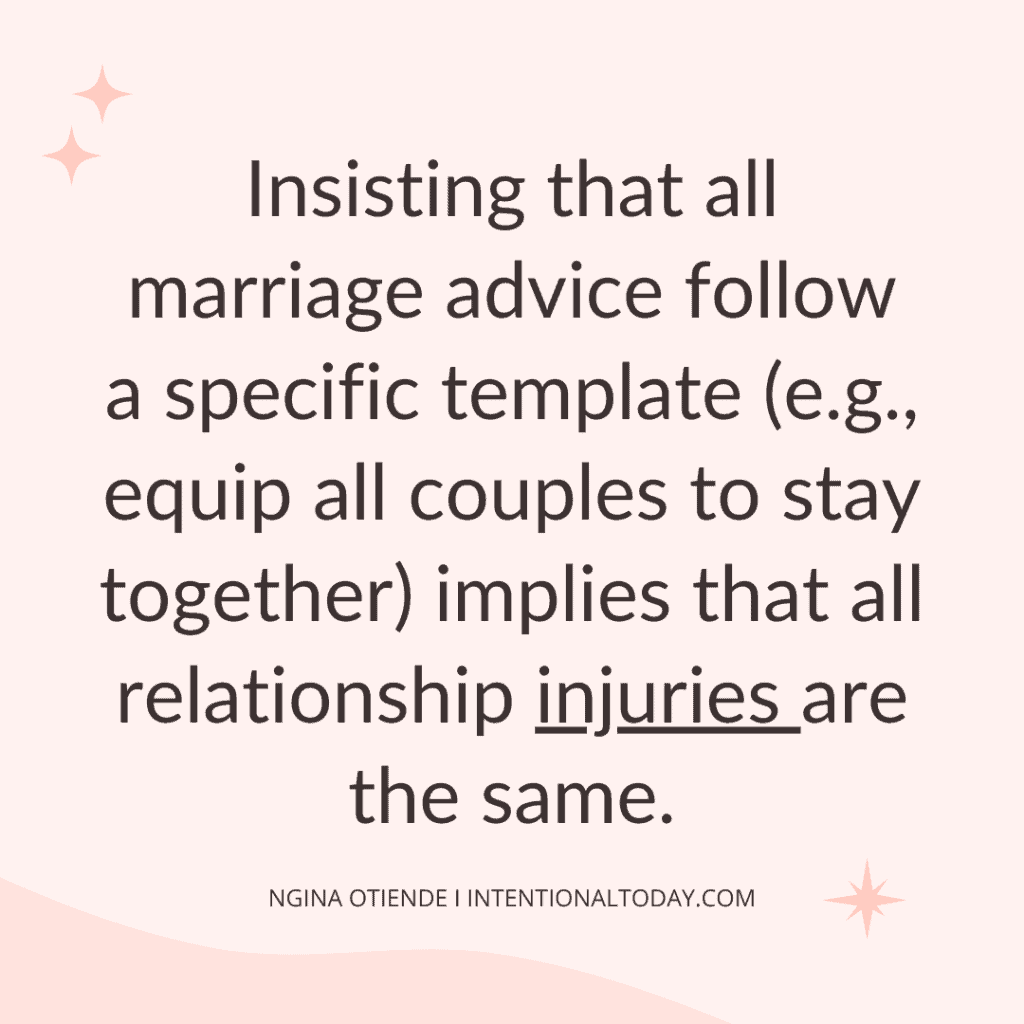
I wish pastors and teachers realize that they are not encouraging people to fight for their marriages when they disparage divorce.
Rather they are attacking, intimidating and shaming those who need to escape for life-saving reasons. Read More Christian Women Are Not Escaping Healthy Marriages, Things Men Say to Female Writers (and Other Pro-Health Content Creators)
7. Just because your unhealthy marriage turned around doesn’t mean you cracked the code.
Many Christians believe all marriage problems can be fixed.
This is especially true for formerly high-conflict partners, who now use their past experiences in a difficult marriage to advise others. “Your marriage can be saved. Just do what WE did.”
While their experience might be valid, formerly high-conflict couples who believe they’ve cracked the code fail to make room for the difference between high-conflict partners and abuse in marriage. The two are not (always) the same.
If a couple previously had an unhealthy, immature marriage but now enjoys a healthy relationship, it shows both partners have (cultivated) the capacity to take responsibility for themselves and their part in the relationship.
That aspect of accountability and relational responsibility is something a currently abusive marriage doesn’t have. Read more High-Conflict Couple Vs Abuse in Marriage
8. What I wish Christians understood about destructive marriages: Christians who feel entitled to power and control are not lacking spiritual interventions
Hardhearted individuals are not lacking prayers, understanding, patience, or hope.
They don’t harm because someone is not praying enough or submitting enough or forgiving enough. They harm and hurt others because they choose to.
Asking the betrayed, the abandoned, the exploited, and the harmed to keep praying for their perpetrator or stay in the relationship is wicked.
I wish Christians understood that prayer cannot replace reflection or the work of true repentance. I wish Christians can understand that spiritualizing aspects of human relationships, often done to the inconvenience of the one suffering is spiritual manipulation and abuse.
Prayer won’t repair where human input is needed.
Obviously, prayer is one way Christians commune with the Divine. And everyone is free to pray for whomever they want to pray for. However, just because a practice sounds spiritual doesn’t mean it cannot be used to manipulate or re-traumatize others. Read More What Harmful Spouses Need (And Why It’s Not More Prayer)
9. Christians in healthy marriages might just be lucky.
I remember our courtship do’s and don’ts.
My husband and I had a long list from my fundamentalist evangelical missionary church of what constituted “godly courtship.” We checked all the boxes. Well, almost, because we occasionally held hands and hugged.
But we did almost everything the church asked us to do. And we survived the church’s obsessions, and are happily, healthily married. Read More 15th Wedding Anniversary – Reflections and Hope
But I also know women from our church who followed the church’s prescription as we did and ended up with addicted, betraying, abandoning, controlling, violent spouses.
They also prayed. Also fasted. Also sought pastoral “approval.” Had pre-marital counseling. All.the.things. Same process for the most part but different outcomes.
Many say “Christian faith” secures a safe, happy, successful marriage. But the truth is faith does not guarantee some things. And we who are healthily married need to accept that so we dial down our chest-thumping. Read More Why Christians in Safe, Healthy Marriages Might Just Be Lucky

10. What I Wish Christians understood about destructive marriages: Saying “Sorry” doesn’t earn someone the right to stay.
I wish more Christians understood that saying “sorry” and starting to do the work of recovery and healing isn’t a ticket to someone’s heart or home.
In fact, a recovering abusive husband who uses his recovery as a bargaining chip to convince his wife to stay is all the evidence that he is still unsafe.
His “I’m sorry, I’m working to be a better man..you need to do your part and show you’re committed to this marriage by not leaving” is more of a giant red flag than a green flag. Read More If Her Abusive Husband is in Recovery, Shouldn’t a Wife Stay?
What I Wish Christians understood about destructive marriages
There’s a lot more I wish Christians understood about emotional, verbal, physical, sexual, financial, psychological, cultural violence in relationships. But these 10 are top of mind today.
Courage: Reflections and Liberation for the Hurting Soul:
A healthy, and committed relationship takes two. But in the Christian world, we often hear that you can fix your partner’s harming/chronically hurting ways if you ignore your limits, shrink your needs, and absorb all the responsibilities of the marriage.
Of course the latter parts are unsaid. But it’s really what people are saying when they ask the hurting party to change their bad marriage all by themselves. The reality is that marriage is not designed to operate on the goodness or decency of one spouse.
If you are tired of being told to take your place in the valley of desolation, Courage: Reflections and Liberation for the Hurting Soul, my debut collection of reflections is for you. Order Courage Now
Thank you. I ended things after 20 years, in 2020. I discovered something was very wrong the week of the honeymoon. I did all the things the church said to do. To the best of my ability. I wish I had walked that week. 19.5 years before I did. But the Shame and pressure of the religious family and people in my life, and my own perfectionism and religion kept me glued. 5 kids later, we are still cleaning up the mess and uncovering all the lies. I know He is making beauty from ashes. But I hate that my children have to weather the storms.
Your blog has blessed me so much in the aftermath. Thank you.
Laura, I’m so sorry. The church culture and our teachings have contributed to so much harm. Yet, we’re supposed to be the liberation people.
I’m glad the blog has been affirming.
Thank You!
❤️
Thank you for your blog . I’ve been in a troublesome marriage for nearly 30 years . I’ve tried too many times to let my husband know that I’m not interested in sex .. he tells me to buy pills to build up my sex drive .. nothing works .. I know it’s because I’ve lost all interest in it and in the marriage . I tell myself to just submit and the sooner it’s done and over with . I’m completely depleted . He’s been abusive in all areas through the whole marriage . I have reacted to this abuse also in terrible ways I would never do to anyone . I have wished him dead etc . I am still with him ..I tried leave on a few occasions but he has begged me to stay . He works hard etc . We have had 5 kids together . They are all on there own or married . I know in n my mind it has taken a tole on me . I try to not burden anyone with my troubles . Daily lay my cares and concerns before the Lord . I don’t want to leave but lately it’s all I think of . Then he’s nice again for a few days and then it starts again . I know I give in to his manipulative ways because it’s what works though I also know it’s wrong . Thank you for your Blog and for letting us write to you .
Peggy